
Amid the uncertainty, the International Cricket Council (ICC) issued a statement addressed to Pakistan.
However, the governing body’s role and neutrality have once again come under scrutiny. Former Pakistani cricketers and analysts have frequently accused the ICC of lacking impartiality and following “double standards”.
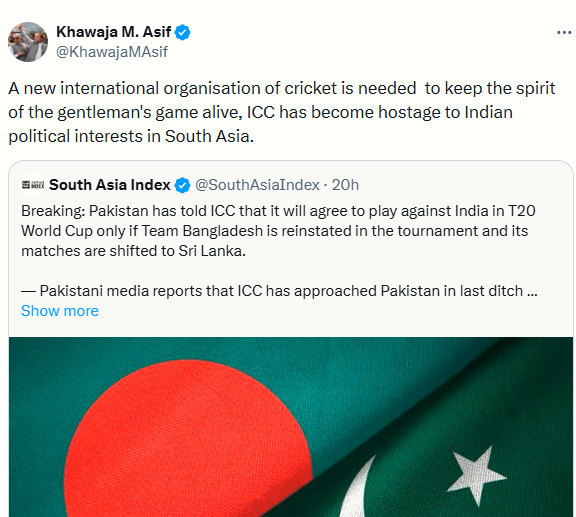
This time, Pakistan’s defence minister Khawaja Asif has gone a step further, calling for the formation of a new international cricket governing body, claiming the ICC has become captive to India’s political interests.
In a post on X (formerly Twitter), Asif wrote:

“A new international organisation of cricket is needed to keep the spirit of the gentleman's game alive, ICC has become hostage to Indian political interests in South Asia.”
India’s economic dominance in world cricket is widely acknowledged, making it the most influential force in the sport. Critics argue that this financial power translates into disproportionate influence over ICC decision-making.
A significant portion of this revenue comes from the Indian Premier League (IPL), the world’s most lucrative T20 franchise competition. Between 2024 and 2027, the IPL is projected to generate more than USD 11.5 billion, accounting for nearly 39 percent of the ICC’s total annual revenue.
Overall, an estimated 70–80 percent of global cricket revenue is derived from the Indian market. India’s domestic media rights alone are now valued at over USD 3 billion.
While the ICC maintains that revenue distribution is based purely on mathematical formulas tied to income generation, critics argue the system inherently favours India.